Tom Beebe’s Tax Reforms
Nobody Gets Email
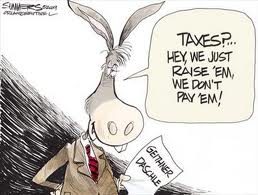
As many of may or may not know, this dribble the Congress is doing about Bush’s tax cuts staying in our paychecks is going to make us all very happy campers, what they are NOT mentioning is the malicious taxes that are going to go sky-high as soon as Obama is out of office, in 2013. It wasn’t just Obama that did Obamacare, and there should be some kind of law saying that a sitting President and Congress cannot pass laws and taxes, which only kick in AFTER the next election.
HA!
What do you expect? Decency? Honesty? Representatives of the people? We have a liar of great magnitude for a President, and a Congress that is just as bad. Perry’s right…they should all stay home.
This was sent to me by a NOBODY who has given a decent proposal, for serious tax reform. It shares a few shades of commonality with Herman Cain I believe, but it’s his own idea. I’m sure he would appreciate any comments that you would like to give on his ideas.
(Thanks to Tom Beebe for sending this in.) 
Part One
A PLAN TO REFORM TAXES AND ENTITLEMENTS
What is, to YOU, a fair tax plan? How can “entitlements”, including welfare, Medicare, Medicaid, and Social Security, be improved? Consider these ideas and please tell me your thoughts on them. You can make this plan even better, and you can send it on to your Senators and congressmen to influence their votes.Americaneeds something better, something more honest, and above all something we can all understand. Please send your thoughts to me too.
Tom Beebe -or- tbeebe6535@yahoo.com
This is a proposal to replace all federal taxes and transfer payments, also known as “entitlements” with a single act. Please understand that “all federal taxes” includes many that we pay each day, such as the tax on each gallon of gasoline, or the corporate taxes which are paid each time you purchase a product or service from a corporation; where else but from you, their customer, do corporations get money to pay taxes? Furthermore, these taxes are multiplied many times on their way from the source of the product to you. Taxes are paid by the retailer with whom you trade. He, in turn, pays his supplier taxes as part of the price of his purchases, and on down the road. You have a right to know, and will be astonished to know, how much you are paying in taxes. This plan is an attempt to reveal that amount by consolidating all taxes into one payment. Remember that by eliminating the hidden taxes, the cost of your purchases will come down drastically. This is one of two ways this plan is aggressively “progressive”, a term describing taxes which are easier on the lower income households who spend a greater part of their income. The second element of this “progressivity” is the large personal exemptions.
The annual personal exemption is set as 2000 times the minimum hourly wage (2000 = 50 weeks times 40 hours per week). We have adopted a minimum wage as the least a worker should receive for his efforts. How, then, can we justify taking some of that sum from him in taxes? This exemption is allowed for every adult (20-65) in your household, and is reduced in steps for those younger, and increased in steps for those older, recognizing the differences in the cost of living to these on the opposite ends of the age span. This formula may be too much or too little as the economy changes, so the plan requires Congress to reset the wage each year, In that “resetting”, Congress will be determining the federal budget, which will be forever balanced. Actually, because Congress has overspent for decades, the plan uses the past year’s taxable income times the new flat tax rate, also set each year. Result? As long as the economy grows (as it does almost every year), a modest surplus will develop to pay off the debt over a period of many years. When the economy grows rapidly, the amount taken out to repay the debt is larger; in a recession, that amount is smaller, as is the budget for government spending.
Now beyond “transparency” the idea that you ought to know what taxes you’re paying, and “progressivity”, the idea that taxes ought to be paid (more) by those more able to pay them, what other modification to the idea of everyone paying the same, the “fair share” of taxes should be part of the plan? It’s reasonable that government policy should be designed to maximize growth, again for two reasons. First, “growth”, an increase in the wealth from which we all share, is in the interest of all. Second, growth means an increasing tax base. That in turn means more money to pay for legitimate government expenditures, like roads, law enforcement and other services without an increase in the tax rate. If this growth in the tax base exceeds the growth in the cost of government services, we’re getting more for the same portion of your income. We all want that.
What contributes to that growth? “Crony capitalism” and corruption resulted in a lot of special deals that contribute to the growth represented by and for special interests. A plan good for no special interest is good for us all. This plan suggests three things are of universal value in assisting growth. Those three are education, health care and investment. So this plan exempts those three expenses from taxable income. It does so broadly, so that government is not telling you what educational choices you make, what health care (and health care insurance) you buy, and what investments you make, (and charity is an investment). You can make those choices better than can Washington.
Many states and cities have been getting into financial trouble. It is not the Federal government’s duty to bail them out, or even correct the practices that got them in trouble. But if this plan makes sense, if it could correct the revenue problems that the other levels of government have encountered, then the federal government can help them out by making the plan available, optionally, to them. But the feds should not impose anything on those other levels of government.
Finally, after all the exemptions are taken, some will have more exemptions than deductions. Should they be helped, and to what extent? Consider calculating aid by multiplying their shortfall by the flat tax rate. As with taxes, their assistance will be reviewed by and adjusted as part of the budget process each year. That way, everybody pays the same rate from top, the “billionaires” to bottom, the least among us. For those whose income exceeds exemptions, they pay taxes equal to the rate times the excess. For the least among us, their income supplement, replacing Welfare, Medicaid, Medicare, Social Security and other “entitlements”, is reduced at the same rate. Is this fair to all?
Finally, if you have read plans that embrace sales or value-added taxes in lieu of or in addition to income taxes such as this, consider that an unlimited exemption for savings makes this plan exactly like s sales tax; if what you save is exempt, then you’re only paying taxes on what you spend.
3 Comments »
Leave a comment
About
 I am a nobody. If the different classes of America were color-coded, I would be in the yucky brown, one rung up from the bottom. I grew up in Naples, Florida and live near the Mississippi River now with my husband and two dogs. I am part of the slowly disappearing middle-class. I was a musician most of my life: drummer/singer/keyboards—but I retired before the plastic surgery flu hit. I have no degrees, which could be a good thing…depending on how you view our educational system. I do have three patents…but that really doesn’t make me a somebody. The one thing that is constant in my life is my OPINIONS, which i have more than perhaps even Carl Sagan could have imagined…mostly political. (yes…my ancestors were crabby buggers)
Hopefully other nobody’s will put their opinions on my site. But, if you happen to be a somebody, you’re more than welcomed to help out.
It’s my Nobody Opinion that Nobody’s Perfect, and Nobody Cares, that Nobody Knows why Nobody Wins, and when that happens, Nobody Wonders, why Nobody Flashes, why Nobody’s Fooled, but then Nobody remembers that Nobody ALWAYS Reports the truth.
You can email me at joyanna_adams@yahoo.com
Joyanna Adams
Comments
Anonymous on MTGA (Make TRUMP Go Away) ronita on MTGA (Make TRUMP Go Away) ronita on MTGA (Make TRUMP Go Away) Mrs. O on MTGA (Make TRUMP Go Away) Joyanna Adams on DAD: It Only Takes a Moment or…


 Joyanna Adams
Tom, the one thing you left out of the fair tax is the rebate that family would get. Just to keep your numbers going the Family of four making $30,000 would get a rebate of $575 a month. The hidden taxes they already pay would be removed, i.e., federal gas taxes, etc. so their costs would go down. If they bought a used car, which they probably would, there would be no tax for them to pay. So on a monthly basis their income is: $2500 plus $575. I will go and look at your sheet but I am not quite ready to dismiss the fair tax just yet. It is time to think outside the box and consider all options. The fact that we have based so much of our tax on income with all the loopholes as to what income really is (income vs. capital gains) might not be the best way to go. It still relies on people filing tax forms and being honest about it and doesn’t gather up those that currently do not pay taxes now.
LikeLike
Dancer, I’ve heard the “fair tax” and “flat tax” cases and rejected them; here’s why. Take a small family of four earning $30,000 a year. I’d bet they spend every cent. That means if their state and local governments have a combined 7.5% sales tax, they’re paying $2250 in taxes, “bite” by “bite’, and don’t realize what it adds up to. I start with a deduction greater than their income, and with the capability for the states and locatities to sign on to this plan OPTIONALLY, so they actually would get some money back. And if their income was greater than the deductions, they’d see four times a year how much they’re paying. I’m aiming to improve the lot of folks like these who earn too much to get welfare and too little to get by. And I’m aiming to help them with health care and education so we could do away with all the “great society” programs in those areas. This plan is at once simpler than the flat tax proposals and more complex because it covers more territory, a LOT more. I appreciate your comments and hope you read the next part in Joyanna’s blog. If you’d like the tax form in an Excel spreadsheet that allows you to play with deductions and rates, email me. Thanks again tbeebe6535@yahoo.com
LikeLike
This sounds similar to the Fair Tax. You can read more about it at Fairtax.org. It is a good idea to use a sales tax where the consumer has some control over what they buy and how much they pay. It also collects tax from those who do not normally pay taxes, i.e., illegal aliens, prostitutes, drug dealers, treasury secretaries, etc. By making it a visible tax everyone will know right off when Congress screws with it. It also shrinks the IRS drown to a very small number. Imagine a world without the threat of IRS hanging over you all the time. And a tax based on consumption rather than income levels the playing field for all of us.
LikeLike