Nobody Remembers Benjamin Franklin and the Indians
Nobody Remembers
On May 9, 1754, a political cartoon in Benjamin Franklin’s Pennsylvania Gazette depicted a snake cut into eight pieces, each section representing a part of the American colonies; the caption read, “JOIN, or DIE.”
I wonder if Benjamin Franklin would have ever believed that his famous drawing would now be an icon on tee-shirts and flags, and sold in every Mall in the year 2013?
Benjamin Franklin was such an important part of our founding, it’s a wonder that more of his words are not taught in school. While John Adams once remarked that Ben Franklin never followed his own witty sayings, unless you are a historian, you probably missed some of his other opinions: Like the one he had on Indians.
Here’s’ some quotes from:The Futility of Educating the Indians, from a letter he wrote to Peter Collinson, on May 9, 1753.
The proneness of Human nature to a life of ease, of freedom from care and labor, appears strongly in the little success that has hitherto attended every attempt to civilize our American Indians. In their present way of living, almost all their wants are supplied by the spontaneous productions of nature with the addition of very little labor, if hunting and fishing may indeed be called labor, where game is so plenty. They visit us frequently and see the advantages that arts, sciences, and compact societies procure us. They are not deficient in natural understanding: and yet they have never shown any inclination to change their manner of life for ours to learn any of our arts.
He goes on to point out, that whenever the Indians lived among the whites, or even were educated at Harvard, they wanted to go back home and live out their lives as Indians. But when they did go home, the Chiefs thought their education was good for nothing, because they didn’t know how to survive.
His theory on why some cultures are superior to others was this:
So that I am apt to imagine that close societies, subsisting by labor and art, arose first, not from choice but from necessity, when numbers, being driven by war from their hunting grounds and prevented by seas, or by other nations for obtaining other hunting grounds were crowded together into some narrow territories, which without labor could not afford them food.
And he ends with this comment on ‘welfare’
They should, therefore have every encouragement we can invent, and not one motive to diligence subtracted, and the support of the poor should not be by maintaining them in idleness but by employing them in some kind of labor suited to their abilities of body as I am informed, begins to be of late the practice in many parts of England where workhouses are erected for that purpose. If these were general, I should think the poor world be more careful and work voluntarily to lay up something for themselves against a rainy day, rather then run the risk of being obliged to work at the pleasure of others for a bare subsistence and that too under confinement.
Ben tells us that the Indians, did not want to be Americans. Just like the Muslims don’t want to become Americanized.
Back in Franklins’ day, it was believed if you could work, you should. And that perhaps when forced to start working, you would then see that the future is much brighter than living off of welfare. Lessons that would be lost on ‘President’ Obama.
These are the lessons that should be taught in a history class. A teacher could use Franklin’s words to start all kinds of lively discussions in the classroom about today’s world. 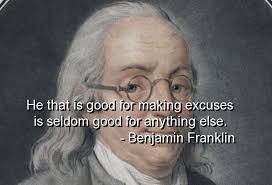
The great Thomas Sowell came to much the same conclusion as Franklin, the physical terrain where you’re people are from play a big part in the culture you grow up with. The Indians didn’t want to become Europeans. Go down this road and you open up a whole can of moral issues don’t you?
The elites of the world are still trying to make all the cultures ‘merge.” They are trying to stuff the round pegs into the square holes. History has shown that it usually doesn’t end well.
The Indians eventually lost their hunting grounds, because they didn’t have a Benjamin Franklin.
3 Comments »
Leave a comment
About
 I am a nobody. If the different classes of America were color-coded, I would be in the yucky brown, one rung up from the bottom. I grew up in Naples, Florida and live near the Mississippi River now with my husband and two dogs. I am part of the slowly disappearing middle-class. I was a musician most of my life: drummer/singer/keyboards—but I retired before the plastic surgery flu hit. I have no degrees, which could be a good thing…depending on how you view our educational system. I do have three patents…but that really doesn’t make me a somebody. The one thing that is constant in my life is my OPINIONS, which i have more than perhaps even Carl Sagan could have imagined…mostly political. (yes…my ancestors were crabby buggers)
Hopefully other nobody’s will put their opinions on my site. But, if you happen to be a somebody, you’re more than welcomed to help out.
It’s my Nobody Opinion that Nobody’s Perfect, and Nobody Cares, that Nobody Knows why Nobody Wins, and when that happens, Nobody Wonders, why Nobody Flashes, why Nobody’s Fooled, but then Nobody remembers that Nobody ALWAYS Reports the truth.
You can email me at joyanna_adams@yahoo.com
Joyanna Adams
Comments
Anonymous on MTGA (Make TRUMP Go Away) ronita on MTGA (Make TRUMP Go Away) ronita on MTGA (Make TRUMP Go Away) Mrs. O on MTGA (Make TRUMP Go Away) Joyanna Adams on DAD: It Only Takes a Moment or…


 Joyanna Adams
“But that drive for progress is a double-edged sword. It depends on dissatisfaction, envy, greed and betrayal, rejection, calumny and a host of other not very nice attitudes. ”
I suppose it was only a butter knife in my case. I was in a poor family of 10 + 3 step siblings, this was a perfect example of dissatisfaction. I worked very hard to progress, all the while maintaining an exemplary attitude.
LikeLike
Proof that competition is a good thing! Somebody tell the elites.
Joyanna Adams
________________________________
LikeLike
It is the nature of the world, shown by history, that ‘peoples’ are sometimes overtaken by other peoples. One might like to think that it is always the case that the ‘superior’ overcome the ‘inferior’. So Darwinian thought goes. But tell that to the proto-nations driven into the slaughterhouse by Ghengis Khan. As good fortune would have it (indeed, has had it) we could be reading still from parchment and have little other ‘art’ than tent tapestry.
Early Americans had the good fortune of not having to create any new ‘art’ or artifact for themselves for a very long time. They had a heritage, brought to them and then taken by them by force. That heritage included pretty well verything about the life they were able to lead, so much in ‘advance’ of the Indians they ‘overcame’. Meanwhile the real progress was continuing an ocean away. Franklin seemed quite envious of that, spending time in Paris instead of on the plains.
The hunting and fishing life of the Indians sounds pretty good. Every striving ‘modern’ person likes the idea of an easy and idyllic life with no pressing need to report into work on monday to be at the beck and call of ‘The Boss’. I can quite imagine the Indians being bemused by what passed for ‘art galleries’ in Franklin’s day and place. They may have resisted being bedazzled by candles and even oil lamps, from which we can learn a lesson or two whenever the next iPad arrives.
But of course the America we know so well has progressed from Franklin’s day of candle-wicks and muddy streets. Modern life has many benefits produced by the ‘drive’ that typifies our western civilisation. But that drive for progress is a double-edged sword. It depends on dissatisfaction, envy, greed and betrayal, rejection, calumny and a host of other not very nice attitudes.
Nowadays, of course, we are faux-bedazzled by primitive art. In Oz we have made a song and dance about Aboriginal song and dance (which is unitelligible tripe as far as I can see) and the childish gibberish of ‘dot’ paintings which have gone from Oz deserts to Paris Galleries. The Didgeridoo produces just the few notes made by fat lips yet is held to be an ‘instrument’ in some corners. They compete with Andy Warhol. Easily. The Indians would have been astonished.
LikeLike